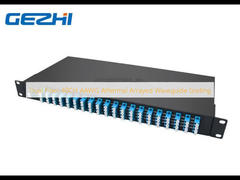
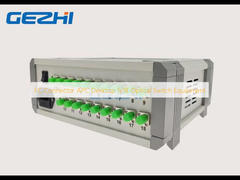
Brief: Let’s dive in — see this solution in action and notice the key moments. In this video, we showcase the Gezhi 1x32 Channels AAWG DWDM Rackmount Module, demonstrating its high-density, passive optical design for metro access and data centers. You'll see how its athermal AWG technology with Gaussian monolithic construction delivers ultra-low loss and excellent channel isolation in a compact 1U rackmount form factor.
Related Product Features:
Features a 1x32 channel configuration based on Athermal Arrayed Waveguide Grating (AAWG) with Gaussian Monolithic Technology.
Provides ultra-low insertion loss with a maximum of 3.5 dB for efficient WDM transmission.
Offers high channel isolation with adjacent channel isolation ≥30 dB and non-adjacent ≥40 dB.
Operates as a standalone passive module requiring no electrical power for installation.
Housed in a high-density 1U 19-inch rackmount chassis for space-efficient deployment.
Supports wavelength selective routing and optical signal processing applications.
Designed for reliable performance in metro access, long-haul networks, and data center environments.
Built-in multiplexer functionality working on single network fibers for simplified fiber handling.
Perguntas frequentes:
What is the operating principle of the 1x32 AAWG DWDM Rackmount Module?
It uses Athermal Arrayed Waveguide Grating (AAWG) with Gaussian Monolithic Technology, a passive optical method to multiplex and demultiplex 32 DWDM channels on a single fiber without requiring power.
What are the typical applications for this rackmount module?
It is designed for wavelength selective routing, WDM transmission, optical signal processing, and is ideal for metro access networks, long-haul networks, and data center interconnects.
What are the key optical performance specifications?
It features ultra-low insertion loss (max 3.5 dB), high channel isolation (adjacent ≥30 dB, non-adjacent ≥40 dB), and operates across the C-band with 100GHz channel spacing, ensuring reliable signal integrity.
Does this module require power or active cooling?
No, it is a completely passive optical device that requires no electrical power or active cooling, contributing to its long-term reliability and ease of deployment.